Thrifted Bookshelf Makeover: $20 Built-In Look
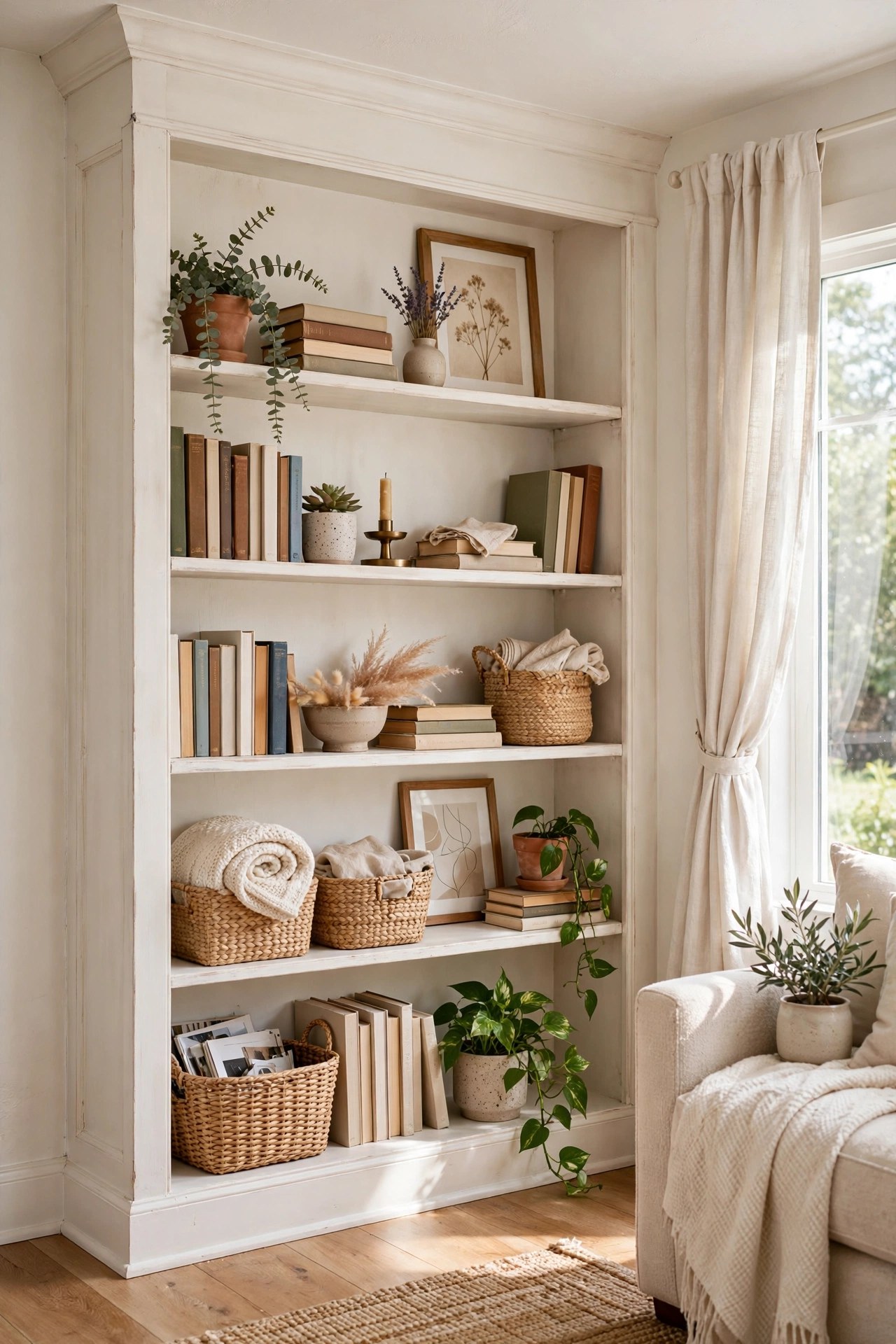
Built-in bookshelves are the holy grail of living room design — and priced like it, with custom millwork starting around $2,000 per wall. But here's what designers know: "built-in" is mostly a visual trick. It's about paint that matches the wall, styling that looks intentional, and anchoring that removes the freestanding wobble. A $10 thrifted bookshelf can do all three.
This project took one weekend and $20: a solid-wood thrift store bookshelf, a quart of warm white paint, and an afternoon of styling. It now looks like it was always part of the room — which is exactly what built-ins are supposed to do.
Materials You'll Need
- Wooden bookshelf (thrifted, solid wood preferred) — $10
- 1 quart satin paint, warm white — $8
- Sanding sponge, medium grit — $2
- Books, plants, and decor for styling — on hand / $0
- Brush, small roller, wood filler — on hand / $0
Step-by-Step Instructions
- Pick the right bookshelf. At the thrift store, look for solid wood (heavy = good), straight shelves, and intact joints. Ignore ugly finishes — you're painting it. Avoid particle board with peeling veneer; it paints poorly and sags under books. Wobble-test it before buying.
- Repair and sand. Fill dings and scratches with wood filler, let it dry, then sand everything with a medium-grit sanding sponge. You don't need to strip the old finish — just scuff it so the new paint grips. Wipe clean with a damp cloth.
- Paint two thin coats. Brush the details and roll the flat surfaces with satin paint in warm white. Thin coats are critical: thick paint pools in corners and shows brush marks. Let the first coat dry fully (4+ hours) before the second. Satin sheen reads as "furniture," not "wall."
- Anchor it to the wall. This is the step that sells the built-in illusion — and the safety step you can't skip. Use furniture straps or L-brackets to secure the top to a wall stud. A tall bookshelf full of books is a tipping hazard, especially with kids or pets. Anchored + flush to the wall = built-in look.
- Paint the wall behind (optional, high impact). If you're feeling bold, paint the wall section behind the shelves the same warm white. When shelf and wall share a color, the eye reads them as one unit — the core of the built-in trick.
- Style like a library, not a storage unit. Arrange books in mixed orientations — some vertical, some in horizontal stacks. Leave breathing room: about a third of each shelf should hold decor (plants, framed photos, baskets, ceramics), not books. Step back often and edit ruthlessly.
Budget Breakdown
| Item | Cost |
|---|---|
| Thrifted wooden bookshelf | $10 |
| Satin paint, warm white (quart) | $8 |
| Sanding sponge | $2 |
| Styling items | $0 (on hand) |
| Brush, roller, wood filler | $0 (on hand) |
| Total | $20 |
Before & After
Before: a honey-oak bookshelf with 90s country styling, priced at $10 and sitting in the thrift store's furniture corner looking deeply unloved. Scuffed edges, a wobbly middle shelf, and that orangey finish that clashes with everything made after 2005. Structurally, though, it was a tank — solid wood, dovetailed drawers, real heft.
After: warm white paint erased two decades in an afternoon. Anchored flush to the wall and styled with books and ceramics, it reads as a custom library wall — the kind of thing that makes people ask who your carpenter was. The $10 price tag is our favorite part of the story.
The biggest surprise was the anchoring. We almost skipped it as "just a safety thing," but pushing the shelf truly flush against the wall — no gap, no wobble — is honestly what makes it look built-in. The paint gets the credit; the brackets do the work.
Tips for Your Own Bookshelf Flip
- Weight-test at the thrift store. Lift one end — solid wood is reassuringly heavy. If it feels like balsa, it's particle board; walk away no matter how pretty the shape.
- Warm white beats stark white. Pure white bookshelves can look plasticky. A warm white (with a hint of cream) reads as custom millwork and hides dust better.
- Always anchor tall furniture. This isn't optional decor advice — unanchored bookshelves injure thousands of kids yearly. Two L-brackets and a stud finder, done in 15 minutes.
- The rule of thirds for styling: roughly a third books vertical, a third books stacked horizontal, a third decor and empty space. Crammed shelves look like storage; breathing shelves look like design.
- Paint the back panel too. Amateurs skip the interior back; pros know it's the most visible part. Two coats everywhere, no shortcuts.
Frequently Asked Questions
- What if the bookshelf has a bad smell (smoke, musty)?
- Air it outside for a few days first. Then seal it: a coat of shellac-based primer (like BIN) locks in odors before your topcoat. For mild mustiness, wiping with a vinegar-water solution and thorough drying often does the trick.
- Can I do this with a laminate/particle board shelf?
- It's much harder. Laminate needs a bonding primer and still chips easily; sagging particle-board shelves won't hold books long-term. For $10-15 at a thrift store, hold out for solid wood — it's worth the wait.
- How do I find wall studs for anchoring?
- A $10 magnetic stud finder is the simplest tool — it sticks to the drywall screws. Or knock: solid thunk = stud, hollow echo = empty. Anchor into at least one stud; drywall anchors alone aren't enough for a loaded bookshelf.